Francis Halzen Wins 2026 Nobel Prize in Physics for IceCube Neutrino Hunt
Belgian physicist Francis Halzen has won the 2026 Nobel Prize in Physics for his pioneering work on the IceCube Neutrino Observatory — the cubic-kilometre Antarctic detector that turned ghost particles into messengers from the cosmos.
The Royal Swedish Academy of Sciences announced the prize on Tuesday, October 6, honouring Halzen “for decisive contributions to the IceCube Neutrino Observatory and the discovery of high-energy neutrinos of astrophysical origin.” It is the first time since 1992 that the physics prize has been awarded to a single winner. The award carries 12 million Swedish kronor, roughly $1.2 million.
Halzen, 82, is a professor at the University of Wisconsin–Madison. He first proposed building a neutrino telescope in Antarctic ice in 1988 and has served as the project’s principal investigator since 2001. “It was a great surprise and I obviously didn’t expect it,” he told the Nobel press conference, according to Nature, crediting the “courageous people” who joined the project early.
The ghost particles
Neutrinos are among the most elusive particles known: electrically neutral and nearly massless, they stream through the Earth almost undisturbed — trillions pass through your body every second.
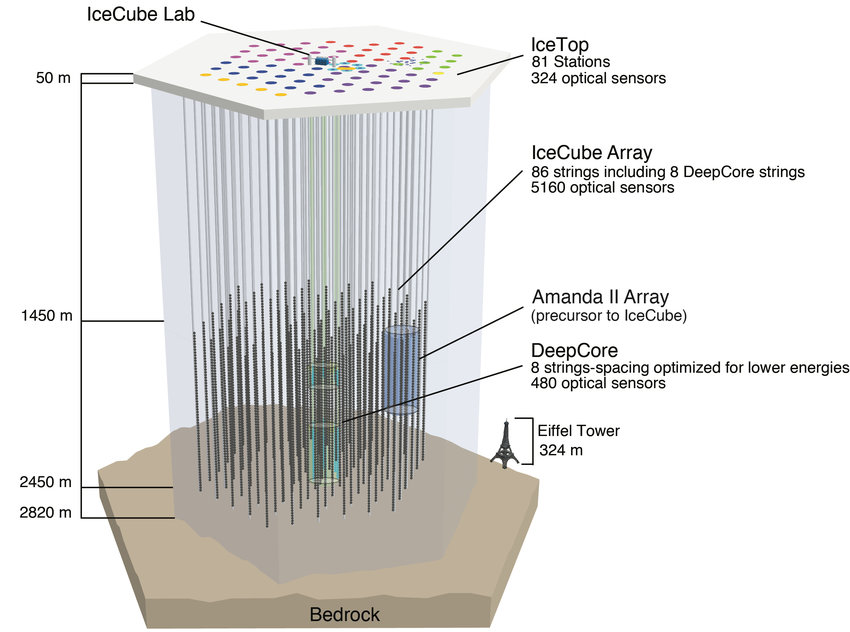
IceCube is that instrument: about 5,160 light sensors embedded in a cubic kilometre of pristine Antarctic ice, built at a cost of $279 million with major U.S. National Science Foundation support and completed in December 2010. When a high-energy neutrino very occasionally collides with an ice molecule, it produces a faint flash of blue light that the sensors record. In 2013 the collaboration reported a persistent flux of high-energy astrophysical neutrinos, and researchers later traced a neutrino back to the blazar TXS 0506+056 — the first strong link between a ghost particle and its cosmic source, with a candidate cluster near the active galaxy NGC 1068.
A new astronomy
The prize recognises the founding of two fields at once: neutrino astronomy and multi-messenger astronomy, in which light, gravitational waves and particles are read together to understand the universe’s most violent events. Plans for an expanded IceCube-Gen2 detector are already in motion, promising sharper views of cosmic accelerators such as supernovae and gamma-ray bursts.
There is a quieter lesson in the citation, too: patience. Thirty-eight years separate Halzen’s proposal from the prize, and the award rewards a whole international collaboration’s stubborn refusal to stop digging — literally — into a cubic kilometre of ice. Readers interested in how science moves from idea to instrument may enjoy our earlier pieces on eye-tracking and early development and electricity-harvesting bone gels. Nature’s coverage of the prize is available here.